

NextGen CEO: AI Strategies for Leadership
Lead AI from enterprise strategy to measurable value
Round Application Deadline
Invalid liquid data
What is the NextGen CEO: AI Strategies for Leadership programme?
The programme develops the executive judgment needed to align stakeholders, negotiate difficult trade-offs, shape talent and workforce strategy and lead organisation-wide change. It also prepares leaders to address trust, human judgment, uncertainty and AI-related incidents or crises. Participants gain the strategic fluency to challenge technology and sourcing choices, oversee responsible governance and guide AI from experimentation to sustained business value.
9 in 10
37%
64%
Gain the NUS Advantage
#1
#10
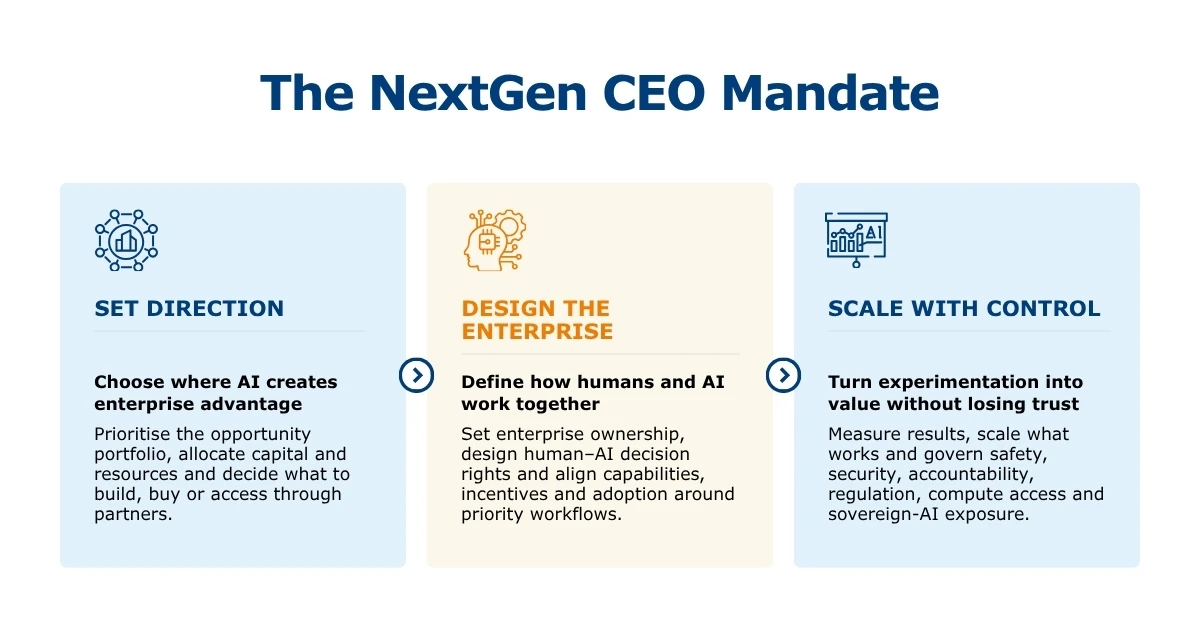
What are the outcomes of the NextGen CEO: AI Strategies for Leadership programme?

Lead enterprise AI strategies and prioritise high-value AI portfolios.

Make informed AI investment, sourcing, and resource-allocation decisions.

Shape enterprise AI operating model, talent strategy, and define human-AI decision rights.

Evaluate open-versus closed-source AI approaches and their strategic implications.

Scale AI initiatives from experimentation to enterprise-wide adoption and measurable value creation.

Establish AI governance, safety, security and regulatory readiness frameworks.

Navigate geopolitical, compute-access, export-control and sovereign AI considerations.

Balance AI capabilities with human intelligence and oversight.

Lead AI transformation and governance discussions at the board and C-suite level.
What are the highlights of the NextGen CEO: AI Strategies for Leadership programme?

Enterprise-level AI leadership
Covers strategy, investment, and governance through executive perspectives.

High-touch live learning
25+ faculty-led sessions plus AI Leadership Series sessions with industry experts.

Holistic learning design
An 11-module progression connecting strategic choices with execution, scaling and governance.

Contemporary AI choices
Explores build–buy–partner decisions, open versus closed models, human–AI decision rights, compute access and sovereign AI.

Applied cases
Understand real-world strategic trade-offs across industries and organisational contexts.

Two-day India immersion
Engage with the NUS faculty and peers in India for in-person learning and executive discussions to enhance leadership capabilities.

Enterprise AI capstone
Applies programme learning to an organisational AI challenge through a guided project.
Who is the programme designed for?
CEOs, CXOs, founders and business owners Shaping the enterprise AI agenda and aligning AI investments with growth and long-term value.
Business unit, P&L and functional leaders Applying AI to strategic priorities while preparing for broader enterprise-level responsibilities.
Digital, technology, data and AI leaders Moving beyond technology delivery to influence enterprise strategy and governance.
Strategy, innovation and transformation leaders Scaling AI beyond experiments, redesigning workflows and driving measurable business outcomes.
Senior executives preparing for expanded leadership roles Building the judgment and confidence to lead AI transformation and contribute to C-suite decisions.
Note: For professionals with minimum 10 years of work experience.No coding or advanced technical background is required.
The NextGen CEO: AI Strategies for Leadership programme curriculum
Module 1: Enterprise AI Leadership and Value Creation
Week 1 - Defining the Enterprise AI Leadership Mandate and Decision Rights
Define the enterprise AI leadership mandate, authority and accountability.
Clarify AI decision rights across the board, C-suite, business, technology and risk functions.
Establish boundaries and escalation thresholds for AI recommendations, autonomous actions and human approval.
Week 2 - Where AI Creates Business Value
Identify AI value levers across growth, cost, productivity, customer experience, resilience and risk.
Map AI opportunities to strategic priorities, value chains and critical workflows.
Distinguish automation, augmentation and business-model innovation opportunities.
Formulate measurable value hypotheses with baselines and accountable owners.
Module 2: Strategic AI Fluency for Business Leaders
Week 3 - Generative AI and Agentic AI: What Senior Leaders Need to Know
Distinguish predictive, generative and agentic AI by strategic capability, limitation and use.
Explain how probabilistic outputs affect reliability, consistency, explainability and decision quality.
Assess material risks arising from hallucination, overconfidence and model variability.
Determine when executive decisions require verification, human judgement or exclusion of AI.
Week 4 - Strategic AI Technology and Sourcing Choices for Executives
Assess the strategic dependencies among enterprise data, models, compute, cloud and applications.
Compare open and closed models and build–buy–partner options.
Evaluate alternatives across performance, control, speed, lifecycle cost, integration, resilience and vendor dependence.
Recommend a sourcing strategy aligned with enterprise priorities and risk appetite.
Module 3: AI Strategy and Portfolio Design
Week 5 - From Use Cases to AI Portfolio Strategy
Translate enterprise strategy into a coherent AI investment portfolio.
Prioritise initiatives by strategic fit, value, feasibility, risk and time to impact.
Balance core improvement, transformation and experimentation.
Sequence investments according to dependencies, capital constraints and organisational capacity.
Week 6 - Geopolitics, Compute Access, and AI Strategy for Asia
Explain how chips, cloud infrastructure, data centres and energy affect AI access, cost and resilience
Analyse export controls, industrial policy and sovereign-AI initiatives across Asia and major global markets.
Assess enterprise exposure across sourcing, data residency, concentration and business continuity.
Define resilience options for critical AI infrastructure and model access.
Module 4: AI-Led Business Models
Week 7 - AI-Led Products, Services and Business Models
Distinguish AI-enhanced offerings from AI-native products, services and business models.
Evaluate AI-driven opportunities for growth, differentiation and new customer value.
Assess monetisation, pricing, data-feedback and ecosystem economics.
Determine the capabilities, partnerships and governance required to launch and scale selected models.
Week 8 - Competitive Strategy in an AI-Driven Market
Analyse how AI changes industry structures, value chains and competitive boundaries.
Identify defensible sources of AI-enabled competitive advantage.
Evaluate threats from incumbents, AI-native entrants and platform providers.
Decide where the enterprise should lead, match, partner, acquire or exit.
Module 5: AI Operating Model and Governance
Week 9 - AI Operating Model: Centralised, Federated and Hybrid Structures
Compare centralised, federated and hybrid enterprise operating models for AI.
Determine ownership across enterprise teams, business units and control functions.
Allocate lifecycle decision rights, resources, handoffs and escalation paths.
Select an operating model aligned with strategy, scale, capability and risk.
Week 10 - AI Governance Model and Responsible AI Oversight
Define enterprise AI governance principles, risk appetite and accountability.
Determine the roles of the board, executive leadership, business owners and assurance functions.
Evaluate AI inventory, risk-tiering, review, exception and escalation mechanisms.
Formulate a governance model that supports responsible innovation and effective oversight.
Module 6: AI Safety, Risk and Regulatory Readiness
Week 11 - AI Safety and Regulatory Readiness
Distinguish AI safety, alignment, security, operational and compliance risks.
Assess material failure modes and enterprise exposure across the AI lifecycle.
Compare relevant regulatory approaches across the EU, US, India, Singapore and ASEAN.
Evaluate readiness across testing, documentation, monitoring, incident response and executive accountability.
Week 12 - Human-AI Decision Rights and Trust
Classify AI-supported decisions by impact, reversibility, uncertainty and stakeholder consequence.
Select appropriate human-in-, human-on- or human-out-of-the-loop arrangements.
Establish authority thresholds, overrides, escalation and recourse.
Evaluate trust risks arising from automation bias, opacity, overreliance and weak accountability.
Module 7: Scaling AI Transformation
Week 13 - AI Scale-Up Mechanisms: From Pilots to Business-as-Usual
Diagnose strategic, technological, operational and organisational barriers to scaling AI.
Evaluate production readiness across data, integration, reliability, security and service operations.
Determine enterprise enablers including reusable platforms, standards, funding and product ownership.
Develop a phased scale-up roadmap with decision gates, accountabilities and stop-orscale criteria
Week 14 - Leading AI Adoption: Workforce, Workflows and Change
Assess AI’s impact on tasks, workflows, roles and workforce composition.
Determine workflow redesign, reskilling, hiring and redeployment priorities.
Develop an enterprise change agenda covering leadership, culture, incentives, communication and learning.
Define workforce and adoption outcomes for executive oversight.
Module 8: Future of Enterprise AI
Week 15 - Agentic AI and Autonomous Workflows
Distinguish assistants, copilots and agentic systems by autonomy, control and accountability.
Evaluate enterprise workflows for agentic redesign.
Assess the strategic value and material risks of autonomous workflows.
Set executive guardrails for permissions, human checkpoints, monitoring and fallback.
Week 16 - AI Strategy Under Uncertainty
Identify technological, economic, competitive, regulatory and geopolitical uncertainties affecting AI strategy.
Construct alternative scenarios and observable strategic signposts.
Apply real-options logic to staged, reversible and scalable commitments.
Establish review triggers and contingency choices for adapting enterprise strategy.
Module 9: AI-Led Transformation Across Business Functions
Week 17 - AI-Led Customer Growth, Marketing and Sales Transformation
Analyse how AI can reshape customer journeys and commercial processes across marketing, sales and service.
Redesign end-to-end workflows and human–AI roles across acquisition, personalisation, conversion, retention and service.
Evaluate customer-data, consent, fairness, transparency and brand-trust implications.
Define commercial outcomes, performance measures and governance requirements for AI-led transformation.
Week 18 - AI-Led Transformation of Operations, Supply Chain, Finance and Risk
Analyse AI-led transformation opportunities across operations, supply chain, finance and risk.
Evaluate interdependencies across planning, execution, financial decision-making, controls and risk oversight.
Redesign cross-functional decision flows, human roles, controls and exception-management processes.
Develop an integrated transformation blueprint specifying expected value, dependencies, accountabilities and performance measures.
Module 10: AI Investment and Performance
Week 19 - AI Funding, Cost-to-Serve and ROI Discipline
Estimate the full lifecycle economics of AI, including data, compute, integration, talent, operations and risk.
Compare central, business-unit and co-investment funding models.
Evaluate risk-adjusted business cases using baselines, attribution, time horizons and scenario sensitivity.
Make continue, pivot, scale or stop capital-allocation decisions.
Week 20 - AI Performance Management and Board Reporting
Define balanced indicators across value, adoption, operations, technology and risk.
Establish performance targets, ownership and executive review cadence.
Diagnose value leakage and material deviations requiring intervention.
Use board-level reporting to inform capital reallocation, risk response and strategic decisions.
Module 11: Boardroom Integration and AI Leadership
Week 21 - Integrating the Enterprise AI Agenda
Integrate AI strategy, portfolio, technology, operating model, governance, talent, funding and performance.
Resolve cross-functional dependencies, sequencing choices and enterprise trade-offs.
Align business-unit priorities with enterprise standards and risk appetite.
Develop an enterprise AI roadmap with milestones, executive sponsorship and accountabilities.
Week 22 - Board and C-Suite Leadership of the Enterprise AI Agenda
Frame AI choices for the board and C-suite in terms of strategy, capital, performance, risk, workforce and trust.
Communicate options, uncertainty and trade-offs without unnecessary technical detail.
Formulate clear recommendations, decision asks and accountabilities.
Build alignment among the board, executive team and critical stakeholders around the enterprise AI agenda.
India Immersion
2-Day India Immersion: Anchor the immersion in India’s sovereign-AI positioning and its place in the global AI order, linked to boardroom and war-room exercises
Analyse India’s AI compute, data, talent, policy and innovation ecosystem.
Evaluate the implications of sovereign AI, geopolitics and compute access for enterprise strategy.
Make time-bound capital, governance, safety and scaling decisions in executive simulations.
Defend recommendations using evidence, stakeholder impacts and risk–return trade-offs.
Convert simulation insights into enterprise action priorities.
Enterprise AI capstone
The Enterprise AI Capstone enables you to apply your programme learnings to a real organisational AI challenge through a guided project led by the Programme Leader. It brings together enterprise AI strategy, governance, operating models and transformation to develop a practical roadmap for measurable business impact.
Real-World Case Studies

Balancing AI innovation, market timing and public trust.

Protecting sensitive information while enabling enterprise AI adoption.

Balancing automation, service quality and the role of people.

Weighing openness, controland competitive advantage in AI.

Navigating compute dependence and geopolitical uncertainty.

Exploring how AI can shape differentiated products and new sources of business value.

Examining leadership, governance and board-level oversight.

Responding to shifts in AI competition and economics.
Note:- All brands, products and company names are the property and trademarks™ or registered® trademarks of their respective owners. No affiliation, association or endorsement is implied.
Programme Director

Alex Capri
Senior Lecturer, National University of Singapore (NUS)
Alex Capri teaches at NUS Business School and the NUS Lee Kuan Yew School of Public Policy, where he examines how AI, data sovereignty and geopolitics are reshaping competitio...
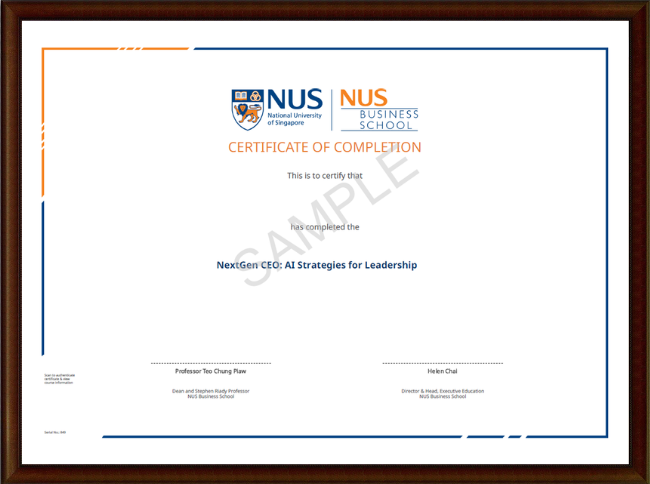
Certificate awarded on completion of the NextGen CEO: AI Strategies for Leadership programme
Upon successful completion of the programme, participants will receive a verified digital certificate from NUS Business School. Successful programme completion requires minimum of 70% attendance in faculty sessions and success completion of capstone project.
Note:
All certificate images are for illustrative purposes only and may be subject to change at the discretion of NUS Business School. Based on relevant guidelines and programme requirements.
Faculty sessions include about twenty-two live-online and four in-person sessions, making it a total of 26 faculty sessions. Exact number of sessions may change as per programme requirements.
Early registrations are encouraged. Seats fill up quickly!
Flexible payment options are available.
Starts On