

Global Chief Strategy Officer (CSO) Programme
Strategic Leadership in the Digital Era
- NUS Business School Certification
- Strategic Focus on AI & Digital
- Campus Experience and Networking Event
- 18 core modules + 4 executive accelerators
The programme learning will pause for holidays during Christmas (23 Dec 2026 – 1 Jan 2027) and Chinese New Year (30 Mar 2027 – 5 Apr 2027).
Future-Proof Your Career
Emeritus and NUS Business School unite to offer an exclusive opportunity. Enrol by Invalid liquid dataand get Invalid liquid dataprogramme fee benefit. Limited seats available. Reserve your spot today!
Application Fee:Invalid liquid data
What is the NUS Business School's Global Chief Strategy Officer Programme in Singapore?
Strategic leadership emerges through the precise alignment of resources to achieve growth and organisational objectives. Modern executives must cultivate financial acumen for strategic decision-making while harnessing AI transformation opportunities to establish an enduring competitive advantage. Leaders must seamlessly integrate their multifaceted responsibilities to optimise organisational positioning within intensely competitive markets.
The Global Chief Strategy Officer (CSO) programme serves as a comprehensive strategic leadership programme, empowering senior executives with theoretical insight and practical tools that transcend traditional business models. As a forward-looking strategic leadership programme, it redefines the executive playbook—preparing participants to lead confidently through uncertainty and drive transformational growth across industries.
57%
53%
What are the Top Priorities of a CSO?
The programme equips CSOs to master the strategic priorities shaping global business growth and transformation.
Shape Global & Regional Strategy Balance global vs. regional priorities Drive customer-led competitive advantage Build alliances & joint ventures in emerging markets
Execute Growth with Resilience Design and scale growth strategies Leverage governance and partnerships Manage risk and build sustainable businesses
Lead with Global Influence Inspire and manage global teams Strengthen executive presence & negotiation power Drive change across diverse markets and cultures
Harness AI & Digital for Strategy Identify high-impact AI opportunities Build AI and digital transformation roadmaps Apply decision-making in the boardroom
Orchestrate Enterprise Execution Bridge strategy and execution at scale Align KPIs across geographies and ESG priorities Lead enterprise-wide transformation with agility
Drive Strategic Financial Impact Translate strategy into financial value Engage CFOs and boards with confidence Align strategic initiatives with capital and valuation
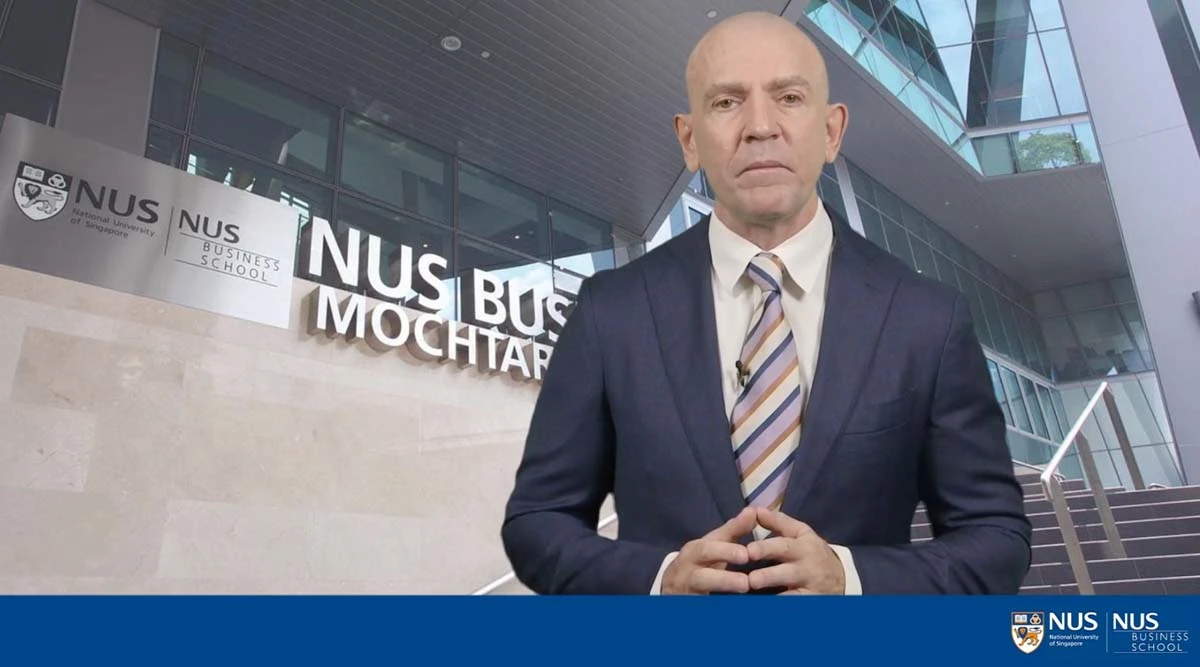
Get a Headstart with a Personalised Tour! Watch this.
Key Highlights of the Global Chief Strategy Officer Programme

Interactive sessions
Leverage interactive sessions with industry experts/faculty and networking sessions with peers

Flexible learning
Pre-Recorded Video Lectures* from NUS Business School faculty for self-paced learning interspersed with live lectures from renowned NUS faculty and industry practitioners

Executive Accelerators
Learn relevant topical courses to gain skill sets specific to your career goals

Strategic Focus on AI & Digital
The programme features dedicated focus on Global Strategy, Executing Growth Strategies & Global Leadership, followed by focused executive accelerators.

Success coach
You will be assigned a success coach who will help craft your learning journey in line with your career goals

Real-world applications
Learn from real-world case studies and business challenges during the programme, and apply the learnings to your job immediately
Comprehensive curriculum
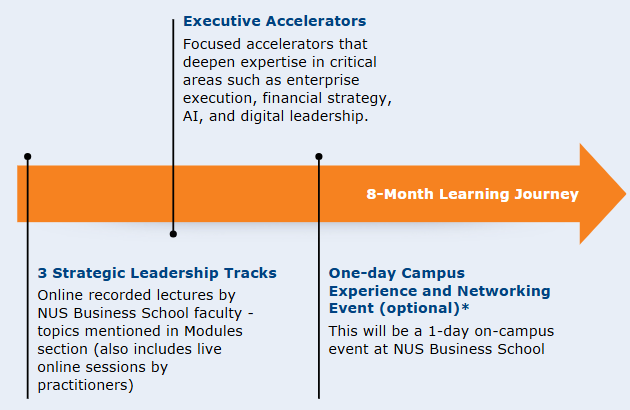
Immerse in an 8-month learning journey that includes in-depth sessions in the latest trends and strategies
Peer interaction
Interact with and learn from high-achieving peers and build your network
Post programme benefits
Following successful completion of the Global CSO programme and subject to further qualification criteria, you have a pathway to become eligible for select post programme benefits
The CSO Playbook
Develop a strategic playbook for yourself through series of exercises

Immersion and Networking
1-day immersion and networking event at the NUS Business School campus (optional)
Note:-*This is a majorly self-paced online programme with some live sessions with programme faculty. Post- session video recordings will be available for up to 12 months after programme completion. We have a curated panel of industry practitioners who will be conducting weekly live sessions for participants to clarify doubts.-Assignments are reviewed either by success coach who is available to support participants in their learning journey and/or by the Emeritus grading team. The final number of quizzes, assignments and discussions will be confirmed closer to the programme start.-For the on-campus networking session, participants will be responsible for making their own travel and accommodation arrangements.
NUS Business School Advantage
1st
1st
Who Should Apply for the Global Chief Strategy Officer (CSO) Programme?
The Global Chief Strategy Officer Programme is designed for the:
Functional and Business Heads: Working towards formulating strategy for your organisation, managing alliances and corporate development
Senior Leaders: Focusing on executing growth initiatives, introducing innovations in different markets, leading business/ functions/ business development in a region
Eligibility Criteria: This programme is designed for business professionals with a minimum of 10 years of work experience, with 5 or more years of management experience, and who have fluency in written and spoken English
Some key designations include: CSO, Vice President, Managing Partner, Director, Executive Director, Chief Business Development Officer, Strategy Consultant, etc.
What Will You Learn from the Global Chief Strategy Officer Programme?

Evaluate strategic initiatives and strategise growth opportunities

Integrate financial insights to strengthen C-suite collaboration

Orchestrate enterprise-wide corporate strategy formulation and execution

Leverage AI technologies to create competitive advantage

Examine organisational performance factors to affect strategic direction

Apply strategic objectives across organisational functions
Testimonials from Past Participants





Participant Pathway
After completing the Core Pillars, you will learn the Executive Accelerators to dive deeper into how senior leaders can use their knowledge and skills in strategy implementation and execution, financial decision making, and AI transformation to address the organisational challenges of tomorrow.
Past Participant Profiles

Engaging and Enriching Experience

Case-based Insights
Learn from real-world case examples and business challenges

Peer Interaction
Interact with and learn from high-achieving peers and build your network

Live sessions by CXOs and Industry Leaders
Gain cutting-edge insights through curated live-online sessions

The CSO Playbook
Assimilate modular learnings through playbook activities

One-on-one with Success Coach
Access to success coach to drive engagement and clarity via live-online sessions

Capstone Project
Work on capstone project and learn with peers from across industries
Global Chief Strategy Officer Programme Curriculum - Core Pillars
Track 1: Global Strategy
Module 1: Strategy as an Organisational Process
Identify a given organisation's strategic framework.
Analyse if the strategy process is linear or iterative.
Generate solutions for closing the gap between actual time spent and desired time spent.
Assess your organisation’s strengths and weaknesses according to the strategy model.
Module 2: Strategy as Guidance
Evaluate a given strategy statement.
Examine if an organisation has a good or poor strategy.
Examine strategic positioning and communication and how they interplay.
Evaluate strategy for cultural strength and communication.
Module 3: Strategy and Customer-Led Competitive Advantage
Articulate a clear positioning strategy.
Apply the three Cs to an organisation and its positioning.
Explain how to position against new competitors.
Examine Domino’s competitive advantage vis-à-vis positioning.
Create a clear positioning strategy statement based on three Cs.
Module 4: Global versus Regional Strategy
Apply the globalisation vs localisation quadrant to an organisation.
Analyse an industry's conducivity to globalisation.
Assess regionalisation–globalisation impact on your industry.
Module 5: Competing in Emerging Markets
Outline the key differences between emerging and developed countries’ markets.
Describe the rewards and challenges of an organisation entering new markets.
Create an emerging market strategy using the six-criteria assessment checklist.
Module 6: Alliances and Joint Ventures in Emerging Markets
Examine the advantages and disadvantages of alliances.
Articulate the risks involved in the acquisition of a specific organisation.
Determine the best ways to manage an alliance relationship to ensure success.
Describe the commonality of a given organisation’s goals vis-à-vis its partner alliances.
Track 2: Executing Growth Strategies
Module 7: Growth as a Strategic Process
Explain the concept of growth and your understanding of good and bad growth.
Create an initial growth plan that includes growth in revenue, profit and capabilities.
Determine how the five pathways impacted an organisation’s growth.
Analyse the relationship between advantages and growth.
Module 8: Business Environmental Analysis and Growth
Determine the importance of PESTEL in your own organisation.
Analyse cross-national variance in institutions.
Construct a constraints profile for a country.
Evaluate your organisational responses to PESTEL and institutional analysis.
Module 9: Partnering Options for Growth
Explain the impact liabilities have on growth.
Demonstrate an understanding of the risks and rewards of partnering strategies.
Assess the effectiveness of mergers and acquisitions on value creation.
Examine the risks, rewards and synergies of an M&A implementation.
Articulate how to implement M&A to reduce risks and enhance rewards.
Module 10: Corporate Governance and Growth
Examine the pros and cons of the two regulatory approaches in corporate governance.
Distinguish how corporate governance enables or inhibits growth.
Identify and analyse the failure of corporate governance.
Apply good corporate governance practices.
Module 11: Growing a Sustainable Business
Explain the evolution of ESG and sustainable business practices.
Outline an initial plan of sustainability practices in your organisation.
Formulate a stakeholder engagement strategy and assess their importance.
Create a plan to transition your organisation towards achieving net zero.
Module 12: Risk Management for Growth
Conduct a risk assessment and identify the risks faced by the organisation.
Determine the need for a tangential vision and identify your organisation's needs and capabilities.
Evaluate risks associated with a strategic objective and explain mitigation and control interventions.
Track 3: Global Leadership
Module 13: Managing Global Teams
Identify constraints and challenges faced by 4D global teams
Develop effective strategies to improve the team's performance and effectiveness
Examine the dynamics of the cultural dimension of a global team
Integrate strategies for leading hybrid and digitally enabled global teams
Module 14: Networking Skills
Highlight the importance of networking skills in leadership
Analyze the strength of your current network
Develop a guide to systematically create the networks you need
Explain the importance of having the right mindset towards networking
Leverage ecosystem and platform-based networking to expand strategic influence as a CSO
Adapt networking strategies for cross-cultural and multi-stakeholder contexts.
Module 15: Executive Presence
List the key features of executive presence
Reflect on understanding yourself and others
Develop strategies for effective communication and storytelling
Demonstrate a holistic and authentic approach to executive presence
Communication strategy during crisis and ESG linked scenarios
Module 16: Understanding Yourself as a Leader
Describe yourself using the notion of self-concept.
Describe how personality traits impact teamwork and performance.
Articulate how self-concept has an impact on your behaviour.
Module 17: Negotiating and Influence
Apply productive nuances and effective elements of successful negotiations.
List and apply the steps in the negotiation process.
Apply negotiation strategies and tactics within a strategic business situation.
Module 18: Leading Change in Organisations
Identify the essential traits in leading change.
Describe the steps in leading change.
Describe a plan to communicate your vision for change.
Complete your action plan to assist the organisation through change.
Sustain effective change practices.
Executive Accelerators
AI for Strategic Advantage
Module 19. Introduction to AI and ML
Understanding the Spectrum of AI: From ML to RPA and Generative AI
Real-World Impact: How Industries are Using AI Today
Scalable Intelligence: Leveraging Cloud Platforms for AI Deployment
Getting Started with AI: Tools and Platforms for Integration
Module 20. AI-powered Strategic Decision Making
AI in the Boardroom: Enhancing Strategic Decisions with Algorithms
Forecasting the Future: Predictive Analytics in Action
AI for What-Ifs: Scenario Planning with Intelligence
Module 21. Identifying AI Opportunities
Spotting the Gaps: Identifying Business Challenges for AI Solutions
The Cutting Edge: Exploring Emerging AI Technologies
Deciding What Matters: Prioritizing AI Initiatives for Impact
Module 22. Building an AI Roadmap and Implementation Strategy
Strategizing AI: Crafting an Implementation Roadmap Aligned to Vision
Critical Success Factors: What Makes AI Integration Work
Measuring What Matters: KPIs for AI Deployment and Outcomes
Module 23. Gen AI and Multimodal AI applications for Business
Unlocking Creative Potential: Business Use Cases of Gen AI and Multimodal AI
Transforming Customer Experience with Multimodal AI
From Content to Commerce: Generative AI for Product and Campaign Design
Ethics and Governance in Generative AI Deployment
Digital Strategy and Transformation
Module 24. Reframing Strategy for Global Impact
Explain how digital strategy creates value beyond technology adoption.
Describe how platforms and ecosystems shape competition.
Differentiate key types of innovation in digital contexts.
Identify capability, customer, people, and culture needs for digital transformation.
Recognise how leadership alignment supports digital change.
Module 25. Driving Transformation and Competing with AI
Describe why organisations struggle with transformation.
Outline key steps leaders use to drive change.
Recognise behavioural and cultural barriers to transformation.
Explain how GenAI and emerging technologies affect industries.
Identify basic opportunities and risks in adopting GenAI.
Execution at Scale – Orchestrating Transformation at the Enterprise Level
Module 26. From Strategy to Execution: Foundations and Alignment
Understand the key differences between strategy formulation and strategy execution.
Apply the Plan–Communicate–Align–Monitor approach to translate strategy into actionable steps.
Use communication tools effectively to support execution (stories, symbols, visuals, leadership shadow, metrics).
Analyse execution challenges using the SCIP framework (Structure, Culture, Incentives, People).
Extract insights from real-world execution examples
Module 27. Executing at Scale: KPIs, ESG, Regions and New Frontiers
Translate strategy into objectives, initiatives, and measures using the Balanced Scorecard.
Align execution through incentives, job design, and organisational processes.
Understand how execution varies across regions and diverse operating contexts.
Integrate ESG goals into execution roadmaps and performance metrics.
Explore how AI-enabled execution improves monitoring and adjustment.
Understand the role of ecosystem partnerships in driving execution at scale.
Financial Acumen for CSO
Module 28: Financial Acumen for Strategic Decision-Making and Driving Value
Communicate effectively with CFOs and finance leaders using the right metrics.
Evaluate corporate valuation approaches and Investor Relations Strategy to identify and articulate the financial impact of strategic initiatives in a clear, executive context.
Leverage high-level financial modeling to interpret data trends and inform strategic planning.
Understand how different sources of financing affect decision making.
Module 29: Board-Level Financial Narratives
Using an application of a merger analysis case study, discuss how to integrate strategic financial planning and forecasting with overall business strategy, ensuring cohesive decision-making with the CFO and executive team.
Strategic risk modeling and downside mitigation. Managing uncertainties and the role of contingent payments.
Analyze ESG-linked financial impact, risks, and opportunities.
Discuss how strategy can help finance in the context of raising new capital for expansion.
The modules/topics/courses are indicative and may change as per course requirements without prior notice.
1-day Campus Experience and Networking Event (Optional to Attend)*
This 1-day campus experience and networking event will occur in Singapore as a wrap-up to the programme.
Note:
-*The campus experience date will be confirmed closer to the end of the programme based on the confirmation from the school and relevant stakeholders.
- This is primarily a self-paced online programme, supplemented with select live sessions led by faculty and industry experts. Recordings of these live sessions will be available for up to 12 months after programme completion. Participants get the opportunity to interact, discuss, and clarify doubts with a dedicated success coach—an industry expert—through weekly live online sessions.
- Assignments are reviewed either by a success coach who is available to support participants in their learning journey and/or by the Emeritus grading team. The final number of quizzes, assignments and discussions will be confirmed closer to the programme start.
-For the on-campus networking session, participants will be responsible for making their own travel and accommodation arrangements.
Programme Completion Benefits

Access to NUS Business School Executive Education newsletters and selected electronic publications

10% savings on selected NUS Business School Executive Education programmes

Invitations to selected NUS Business School Executive Education events
Note: All benefits are subject to changes.
Industry Expert Session by Emeritus

Competing in a Fragmented World:
Navigating U.S.–China Polarization and Strategic Tensions Across APAC

Boardroom Strategy:
How CSOs Influence Power, Politics & Decision-Making

AI-Native Strategy:
Leading in the Age of Autonomous Decision-Making

Orchestrating Ecosystem Partnerships:
How to Execute Strategy Beyond the Boundaries of the Firm in an Era of Disruption
Note: The above listed topics for industry expert sessions are indicative in nature and are subject to change as per programme requirement without any prior notice.
Industry Examples Covered in the Programme

Toyota, Southwest
Examine how organisations build and realign capabilities over time to respond to technological change, industry disruption, and evolving competitive conditions.

Zoom, KFC China
Explore how firms balance global scale with local adaptation when expanding across regions, emerging markets, and culturally diverse environments.

Boeing 787, Microsoft–LinkedIn
Examine how organisations use alliances, co-opetition, and acquisitions to access capabilities, manage interdependence, and support strategic growth.

IKEA, Duolingo
Appreciate how organisations apply AI and digital technologies to improve products, customer experience, and decisionmaking at scale.

Uber, Wirecard
Examine how organisational culture and risk awareness influence resilience, long-term performance, and strategic sustainability.
Note: The above industry examples are subject to change as per programme requirement without any prior notice.
Programme Faculty of the Global Chief Strategy Officer Programme

Andrew Delios
Professor, Strategy & Policy
Andrew Delios is Professor and Vice-Dean MSc Programmes at NUS Business School. He has also been a Professor in the Department of Strategy and Policy at NUS Business School fo...

Nitin Pangarkar
Associate Professor, Strategy & Policy
Nitin Pangarkar received his PhD from the University of Michigan in 1993. He teaches strategy and international business courses at the NUS Business School, National Universit...

Emily Michelle David
Associate Professor Management And Organisation
Emily M. David is an Associate Professor of Organisational Behaviour at the National University of Singapore (NUS). She earned her PhD in Industrial-Organisational Psychology ...

Lawrence Loh
Professor, Strategy & Policy
Lawrence Loh is Director, Centre for Governance and Sustainability at the NUS Business School, National University of Singapore (NUS). He is also Professor of Strategy and Pol...

Usa Skulkerewathana
Senior Lecturer, Management & Organisation
Prior to joining the university, Usa worked as a Consultant/Trainer with Mercuri International, an international business and sales consulting firm. Currently a senior lecture...

Jussi Samuli Keppo
Professor, Analytics and Operations
Jussi Samuli Keppo teaches risk management and analytics courses, and directs analytics executive education programmes at the National University of Singapore (NUS) Business S...

Hong Ming Tan
Senior Lecturer, Analytics and Operations
Tan Hong Ming is the Deputy Head and Senior Lecturer in the Department of Analytics and Operations at the NUS Business School, National University of Singapore. In this capaci...

Alminas Zaldokas
Associate Professor, Finance
Alminas Žaldokas is currently an Associate Professor in Finance at the National University of Singapore (NUS). He has received his PhD in Finance at INSEAD in 2012. His previo...
Note: Programme Faculty for the live sessions might change due to unavoidable circumstances, and revised details will be shared closer to the programme start date.
Success Coach

Anne Phey
General manager at Leadership Coaching school
Anne Phey is the Founder of Leadership Coaching School and a globally recognized leadership coach with over 30 years of experience at organizations such as IBM and MTV Asia. S...
Strategic Playbook Activities
Structured set of playbook activities enables learners to apply concepts to their organisation or interest area, strengthening strategic thinking, execution discipline, and leadership capability.
Translate learning into practice through structured exercises that connect frameworks (strategy, growth, risk, ESG, culture, and communication) to real organisational contexts.
Develop decision-making readiness by working through tools such as the Three Cs, PESTEL, Ansoff Matrix, risk assessments, negotiation frameworks, and change-management plans.
Build personalised strategic toolkit that enhances clarity, leadership judgment, and cross-functional influence, all documented in a reusable playbook for professional growth.
Certificate
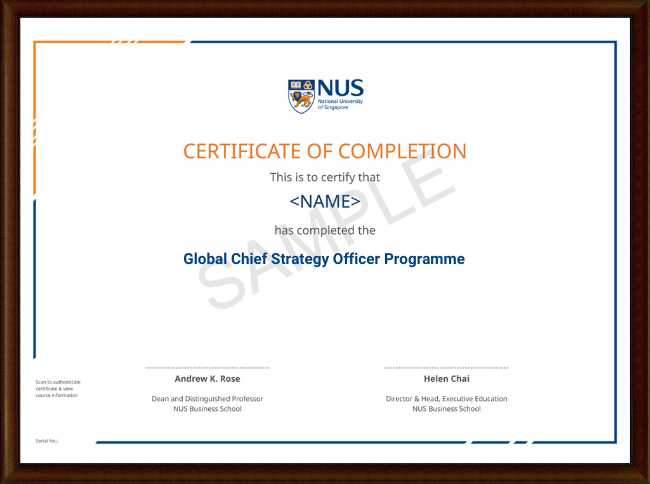
Upon successful completion of the programme, participants will be awarded a verified digital certificate by NUS Business School.
Frequently Asked Questions
What is the eligibility/background required for the NUS Business School's Global Chief Strategy Officer (CSO) Programme?
The CSO Programme is ideal for experienced business professionals with at least 10 years of work experience, including 5 or more years in a management role. Proficiency in written and spoken English is also required
Who should apply for the Global Chief Strategy Officer (CSO) programme ?
The business strategy course is best suited for senior executives, business leaders, and professionals in strategic roles who want to strengthen their expertise in strategy formulation and execution. It is also ideal for those aspiring to transition into a Chief Strategy Officer role or expand their strategic influence within their organisation.
What is the course curriculum of Global Chief Strategy Officer Programme by NUS Business School?
As a well-rounded curriculum of a business strategy course, the curriculum of the Global Chief Strategy Officer programme explores key areas such as global strategy, executing growth strategies, global leadership, and the roles and responsibilities of a Chief Strategy Officer. Taught by leading NUS Business School faculty, the programme combines real-world case studies, interactive sessions, and insights from industry experts to deliver a comprehensive learning experience.
Is the Global Chief Strategy Officer (CSO) programme live or recorded?
The NUS Business School's Global Chief Strategy Officer Programme combines live online sessions with recorded content, offering participants the flexibility to learn at their own pace while also engaging in interactive, real-time discussions.
What is the course fee for NUS Business School's Global Chief Strategy Officer Programme?
The course fee varies based on the session and enrollment period. For the latest fee structure, please refer to the program’s official page or contact the program advisor.
Are there any installment or finance options available?
Yes, installment or finance options are available to help participants manage the course fee in a flexible manner. Details about payment plans can be obtained by reaching out to the program advisor.
What is the role of Chief Strategy Officer?
A Chief Strategy Officer (CSO) drives the overall strategic direction of an organisation. They work closely with the C-suite to identify growth opportunities, explore new markets, execute strategic initiatives, and ensure that business goals align with the company’s vision and long-term objectives.
What is the job description of a Chief Strategy Officer?
The job description of a Chief Strategy Officer includes developing and implementing business strategies, overseeing cross-functional projects, guiding the organization’s long-term planning, and acting as a strategic advisor to the CEO and board.
What is the duration of the Global Chief Strategy Officer (CSO) programme?
The duration of the Chief Strategy Officer programme typically spans for 8 months, combining live sessions and pre recorded sessions for self-paced learning and 1-day of optional immersion and netowrking event at the NUS Business School campus.
Why should I choose the Global Chief Strategy Officer programme?
This programme is considered one of the best for aspiring Chief Strategy Officers due to its comprehensive curriculum, industry-relevant insights, and focus on strategic leadership. The NUS Business School’s reputation for excellence and the program’s focus on real-world application further solidify its value.
Do all participants get certificate of completion?
Upon successful completion of the programme, participants will be awarded a verified digital certificate by NUS Business School.
Are there any networking opportunities in this Global Chief Strategy Officer (CSO) programme?
Upon successful completion of the programme, participants will be invited to attend a 1-day Campus Immersion and Networking Event (optional to attend) at the end of the 8-month journey at NUS Business School. During this event, participants will have the opportunity to network with fellow global leaders and interact with programme faculty/directors.
What are some of the designations that form the cohort of the Global Chief Strategy Officer (CSO) programme?
Some of the key designations are CSO, Chief of Strategy, Vice President, Managing Partner, Director, Executive Director, Chief Business Development officer, Strategy Consultant
What makes this CSO program different from other strategy programmes?
Unlike traditional strategy courses, this programme combines Digital Strategy, AI for Strategic Advantage, and Enterprise Execution. You’ll gain hands-on frameworks to align digital transformation with business vision, orchestrate execution at scale across global functions, and measure outcomes with clear KPIs.
Why is financial acumen included in the curriculum?
Strategic leadership today demands strong financial fluency. The programme builds your ability to evaluate corporate valuation, engage with CFOs using the right metrics, assess ESG-linked risks, and align strategy with investor relations and capital-raising decisions. This ensures that every strategic initiative—from AI adoption to digital transformation—translates into measurable financial impact.
Early registrations are encouraged. Seats fill up quickly!
Flexible payment options are available.
Starts On